
TravlScribl#4: Twilight Zone in Anza-Borrego
Jill Draper on the joys of going off-GPS
The GPS steered us to California’s State Route 78, but we veered instead to SR 22, figuring it might be more scenic. Our reward was a twisting drive through the otherworldly badlands of the Anza-Borrego Desert. Stomachs fluttering, we dipped and crested and dipped again along a two-lane road before it flattened out at a weirdly large traffic circle—the gateway to Borrego Springs, population 3,400.
It was late afternoon, so straight away we headed for the state park visitor center, hidden in a mostly underground building. A staff member stepped out from behind a display of taxidermied wildlife to announce, “The film is starting—it’s a good one.” In the small, dark theater we watched the lives of the Marshal South family unfold. Led by the father, an eccentric author and artist, they spent 17 years without electricity or running water atop the desert’s Ghost Mountain in the 1930s and ’40s as a pre-hippie experiment in primitive living.
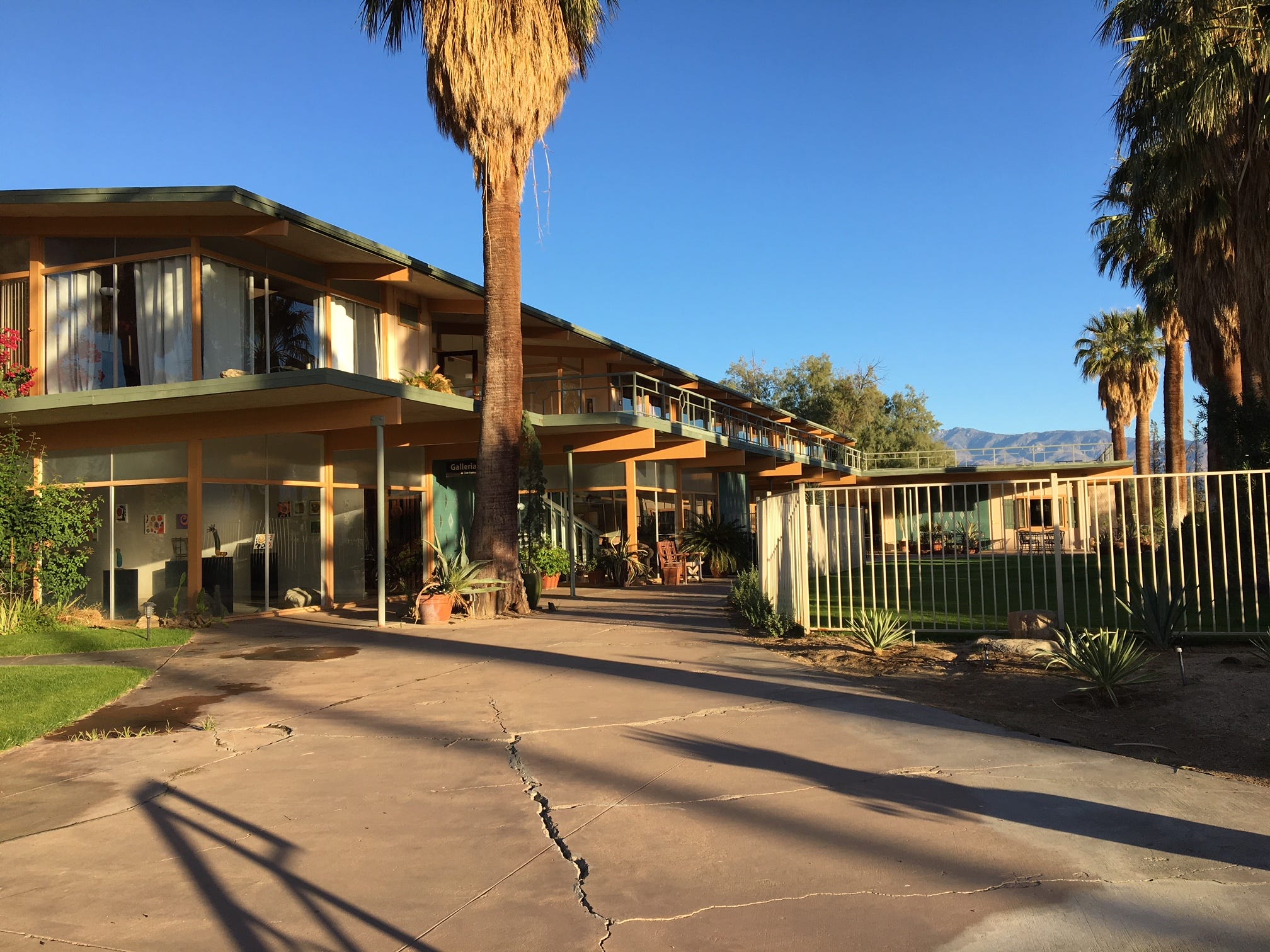
The visitor center shut its doors behind us and we emerged, blinking in the sunlight. Back in town, past a scattering of buildings and down a dusty road, we found The Palms at Indian Head. We had booked this small, retro-chic hotel online. Built in 1947, it burned to the ground a decade later and was rebuilt as an international modern-style resort before falling into disrepair. The property went through a mixed bag of uses as a nudist retreat, a school for handicapped children and a detention facility for bad boys. Some 56 dilapidated bungalows had been destroyed and new owners were fixing up the hotel that remained.
Nobody was there when we arrived. A single lamp lit the front counter where we found two brown envelopes with keys inside: one for the Drappers, room 2, and one for the Drapers, room 10. We took the latter one and carried our luggage upstairs to a room overlooking an Olympic-sized pool where celebrities from yesteryear like Marilyn Monroe, Clark Gable, Bing Crosby and Montgomery Clift once socialized. Their photos lined the walls in the dim lobby, along with a menu from the 1950s (turkey dinner, $2.50; prime rib, $3). Frank Sinatra crooned softly from the sound system.
From the rooftop terrace we watched the setting sun light up the Santa Rosa Mountains with a brief blaze of color. Palm trees rimmed the darkening horizon, while a full-sized metal sculpture of a sea turtle stoically grasped a golf club in its mouth at the pool’s edge. No other cars were in the parking lot. No other guests arrived.
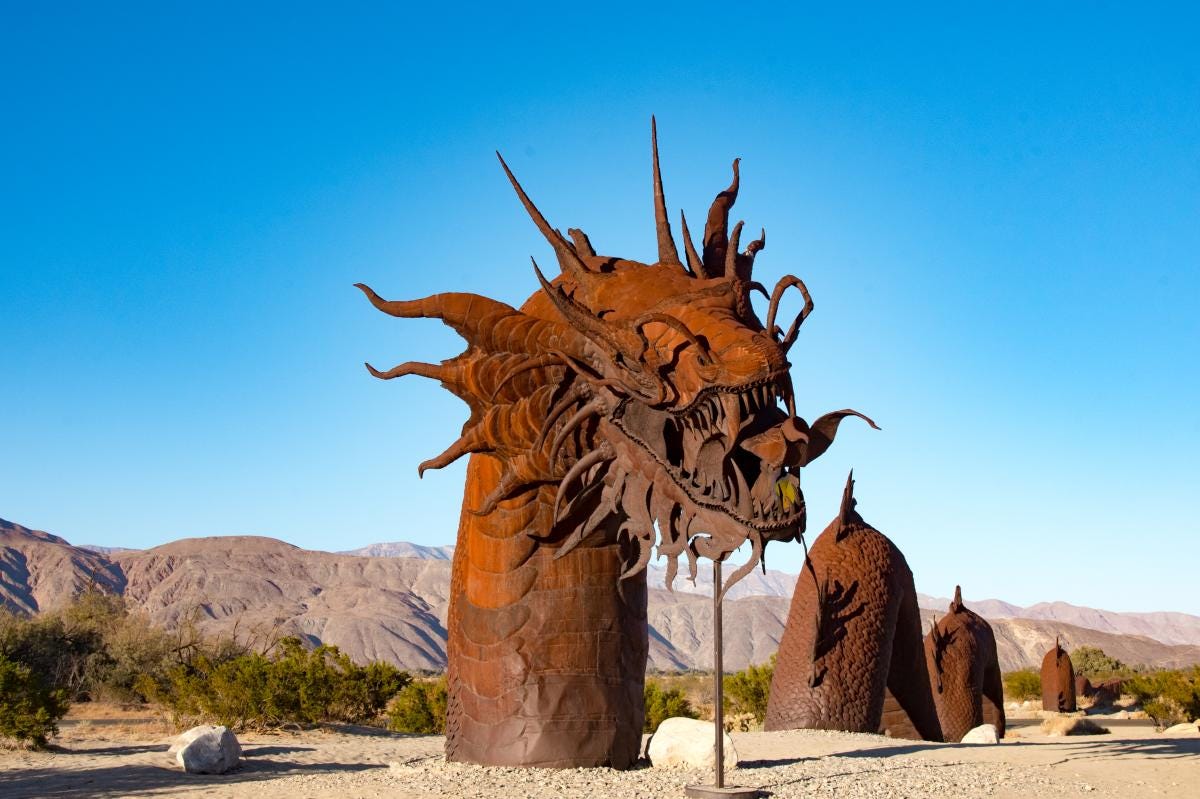
Surrounded by parkland, Borrego Springs is an International Dark Sky Community—the only one in California. It’s also rumored to be the site of a secret underground hideaway for American presidents in case of nuclear war. Popular with artists, it’s best known for the work of Ricardo Breceda, whose giant metal sculptures of prehistoric mammals, dinosaurs and fantastical creatures adorn the desert floor, including a 350-foot-long serpent with coils half buried in the sand.
We slept fitfully that night and the next morning returned our keys to the vacant front counter. The lamp was still on, the background music still playing. The Drappers (our doppelgängers?) had not yet arrived. We headed into town to the Red Ocotillo. The waitress, a woman of a certain age with graying hair pulled back into a jaunty ponytail, gave us a hard stare before asking, “How was your stay at The Palms?”
We looked at each other uneasily. How did she know this? Were we the first new faces she had seen in a long time? (Or did she notice our hotel breakfast coupon on the table?). After eggs and pancakes, we entered the traffic circle, spun round and round until we spied an exit and roared off, taking Montezuma Valley Road east toward the coast.
Hope the Drappers will fare as well.